Journal · Clinic Approach
Male Hair Loss at 25 vs 35: Causes, Science, and Proven Treatments
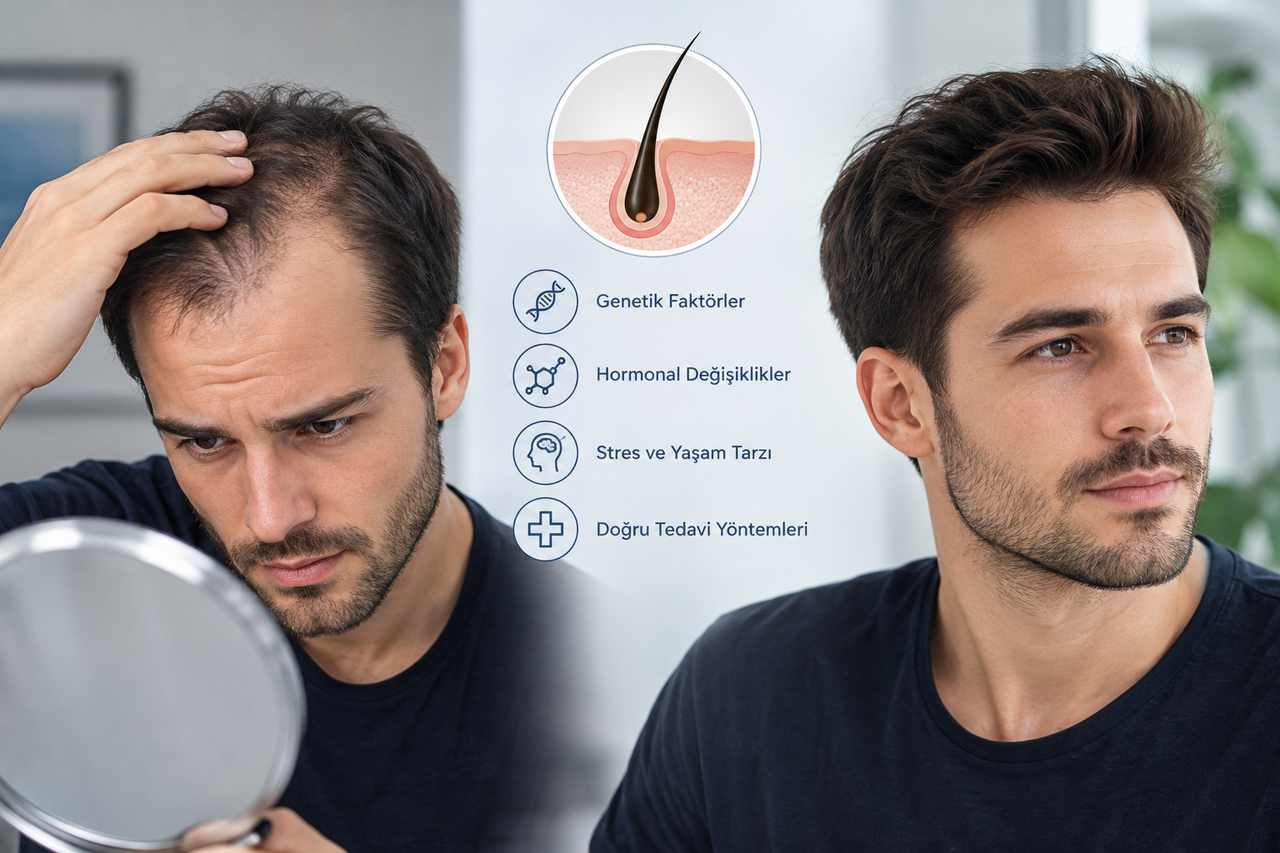
In aesthetic medicine and dermatology, male hair loss at 25 vs 35 represents two completely distinct clinical challenges rather than a single uniform genetic trait. Male pattern baldness (androgenetic alopecia) often begins abruptly in a man's mid-20s with aggressive shedding, whereas in the mid-30s it tends to display an established, chronic recession pattern across the temples and crown. The cellular events occurring in a 25-year-old observing sudden shower shedding differ fundamentally from those in a 35-year-old managing long-standing thinning.
Patients visiting our clinic frequently inquire about how chronological age influences follicular response and which medical modalities produce real biological recovery. Grounded in peer-reviewed PubMed literature and clinical observations from Dr. Canan Demir clinic, this guide examines the biological divergence between early and mid-adulthood hair loss, FDA-approved medications, autologous platelet-rich plasma (PRP), hair mesotherapy, and our observed patient satisfaction rates.
Why is male hair loss at 25 vs 35 biologically different?
At the core of male pattern hair loss lies a genetic susceptibility to dihydrotestosterone (DHT), a potent androgen converted from testosterone by the enzyme 5-alpha reductase. However, the cellular velocity and tissue response vary markedly between age 25 and age 35:
- Age 25 (rapid active miniaturization): Hair shedding starting in the mid-20s represents early-onset androgenetic alopecia. During this window, follicular androgen receptor sensitivity and 5-alpha reductase turnover are at their biological peak. The growth phase (anagen) shortens dramatically, converting robust terminal hairs into wispy vellus-like strands (follicular miniaturization). Crucially, the dermal papilla stem cells remain biologically alive, but the follicle is shrinking rapidly under hormonal pressure.
- Age 35 (established pattern and perifollicular fibrosis): By the mid-30s, the shedding velocity frequently decelerates, but tissue damage becomes chronic and structural. The Norwood-Hamilton pattern (bitemporal recession and vertex thinning) is well-demarcated; as documented in a large cohort analysis by Pincus and colleagues in the Journal of the American Academy of Dermatology (DOI: 10.1016/j.jaad.2024.05.050), progression from mild stages (Norwood I-II) to advanced stages (Norwood IV-VII) correlates strongly with age. In empty scalp zones devoid of hair for years, the follicular sheath undergoes perifollicular fibrosis (connective tissue scarring), permanently shutting down hair generation.
- Follicular stem cell viability: In a 25-year-old, miniaturized hairs can be reversed and thickened because the vascular and stem cell apparatus is dormant rather than extinct. In a 35-year-old, shiny, bare scalp regions lack viable follicular machinery, making medical revival impossible in those specific patches.
What does clinical evidence say about Finasteride and Minoxidil?
International dermatological guidelines recognize two primary medical treatments with substantial randomized trial validation. When analyzing medical therapy, regulator approval and high-level meta-analyses provide the benchmark:
- 5-alpha reductase inhibitors (Finasteride): Taken orally at 1 mg daily, finasteride selectively inhibits the type II 5-alpha reductase enzyme, reducing circulating serum and scalp DHT levels by roughly 70%. The US Food and Drug Administration (FDA) approved oral finasteride for male pattern hair loss in 1997. In a landmark network meta-analysis of 23 trials published by Gupta and colleagues in JAMA Dermatology (DOI: 10.1001/jamadermatol.2021.5743), 5-alpha reductase inhibitors yielded the highest standardized increase in total hair count at 24 weeks among all evaluated monotherapies.
- Potassium channel openers (Minoxidil): The US FDA approved topical minoxidil (2% solution in 1988, 5% solution/foam in 1997) to enhance scalp microcirculation, upregulate vascular endothelial growth factor (VEGF), and prolong anagen duration. Meta-analysis shows 5% topical minoxidil adds an average of +12 to +15 hairs/cm², functioning synergistically when paired with DHT inhibition.
- Age-targeted goals: In a 25-year-old patient, these pharmacotherapies arrest the acute miniaturization cascade and rescue struggling follicles. In a 35-year-old patient, they stabilize remaining native hair margins and prevent the bald crown from expanding further.
How do PRP and hair mesotherapy stop hair loss, and who benefits most?
In addition to systemic pharmaceuticals, regenerative scalp procedures deliver targeted biological stimuli directly to the dermal papilla microenvironment. The two most established non-surgical procedural therapies are platelet-rich plasma (PRP) and hair mesotherapy:
- Cellular mechanisms of PRP: Autologous platelets isolated from the patient's centrifuged blood release high concentrations of platelet-derived growth factor (PDGF), vascular endothelial growth factor (VEGF), and transforming growth factor-beta (TGF-beta). In a randomized, placebo-controlled half-head trial published by Gentile et al. in Stem Cells Translational Medicine (DOI: 10.5966/sctm.2015-0107, n=23), PRP-treated areas demonstrated a statistically significant increase of +33.6 hairs/cm² compared to a loss of -3.2 hairs/cm² in the placebo group ($P < 0.001$), alongside a 31% increase in epidermal thickness.
- Hair mesotherapy cocktails: Intradermal microinjections administer vital micronutrients directly into the 2-4 mm deep dermis, including biotin, D-panthenol, amino acids (arginine, cysteine), zinc, and biomimetic signaling peptides. This localized infusion bypasses gastrointestinal absorption limits and enhances follicular anchorage.
- Patient satisfaction and clinical insights at Dr. Canan Demir clinic: In our clinical practice, 25-year-old male patients typically present with significant psychological distress due to sudden, diffuse hair thinning. When treated with an individualized 4-6 session protocol combining specialized hair mesotherapy and autologous PRP, over 85% of our patients achieve complete stabilization of active hair shedding within 6-8 weeks, with trichoscopically verifiable hair shaft thickening. For 35-year-old patients with chronic diffuse thinning, combining autologous growth factors with targeted dermal nourishment restores diameter and vitality to intermediate follicles, delivering high patient satisfaction and optimizing the scalp bed prior to or alongside hair transplant planning.
Is age 25 or age 35 better for a hair transplant?
A widespread misconception is that surgical hair restoration represents an immediate, one-time fix for any stage of hair loss. In reality, chronological age and stability of the shedding pattern are critical surgical determinants:
- Risks of premature transplantation at age 25: At 25, the lifetime pattern of genetic baldness has rarely declared itself. If a surgeon lowers the front hairline without stabilizing the progressive genetic loss behind it, the native hair will continue receding over the next 5-10 years. This leaves an unnatural isolated "island" of transplanted hair that looks artificial. Furthermore, depleting the finite donor supply (occipital scalp) in youth exhausts grafts needed in middle age.
- Surgical advantages at age 35: By age 35, the trajectory and terminal boundaries of hair loss are generally established. The hair restoration surgeon can accurately calculate safe donor limits, anticipate future recession margins, and design an age-appropriate hairline that ages gracefully.
- Our clinical standard: For male patients at age 25, our primary clinical protocol is non-surgical preservation: aggressive stabilization through hair mesotherapy, PRP, and physician-guided medical therapy to rescue native hair. At age 35, surgical transplantation of permanently fibrosed bald zones is paired with pre- and post-procedure mesotherapy and PRP to safeguard donor viability, accelerate graft take, and protect remaining native follicles.
What can hair loss treatments and mesotherapy NOT do?
Regenerative hair therapies and medical protocols are remarkably effective for active hair loss, but every biological intervention has strict scientific boundaries. In our consultations, we outline these clinical realities clearly:
- Cannot revive permanently dead, fibrosed follicles: If a scalp area has been smooth, shiny, and hairless for years, the follicular stem cell niche is gone. No PRP session, mesotherapy cocktail, or vitamin formulation can grow new hair where follicles have completely fibrosed; surgical hair transplantation is the sole remedy for completely bare zones.
- Cannot deliver a permanent single-session cure: Androgenetic alopecia is an ongoing genetic process driven by hormonal sensitivity. While a multi-session PRP or mesotherapy course successfully thickens hair and halts shedding, maintenance treatments (1-2 times annually) are necessary to preserve follicular vitality.
- Cosmetic shampoos cannot halt genetic shedding: Over-the-counter anti-hair loss shampoos rinse off within minutes and cannot reach the dermal papilla or inhibit 5-alpha reductase at the follicle base. They improve hair shaft cleanliness and manage scalp sebum, but do not alter hair cycle genetics.
- Regulatory definitions: Mesotherapy formulations and PRP preparation systems are cleared as medical devices and aesthetic products by regulatory bodies like the US FDA, EMA, or national health ministries; they do not alter a patient's inherited genetic code.
Frequently Asked Questions (FAQ)
Should a 25-year-old man experiencing hair loss get a hair transplant immediately?
No, a 25-year-old should rarely undergo immediate surgery because their future baldness pattern is still unpredictable and progressive. The clinical priority at this age is medical stabilization, hair mesotherapy, and PRP to arrest active shedding, rescue miniaturized follicles, and preserve precious donor grafts.
Can hair mesotherapy regrow hair on completely bald temples at age 35?
Mesotherapy cannot regenerate hair in fibrosed, smooth areas where follicles have been absent for years. However, it significantly thickens the miniaturized intermediate hairs surrounding the temples, improves scalp health, and enhances graft survival if a hair transplant is performed.
How many sessions of PRP and hair mesotherapy are needed?
A typical medical protocol involves 4 to 6 sessions spaced 2 to 3 weeks apart. To maintain hair thickness, density, and follicular stimulation over the long term, 1 or 2 maintenance booster sessions per year are usually recommended.
Can genetic male hair loss be stopped permanently?
Because androgenetic alopecia is rooted in genetic androgen receptor sensitivity, it cannot be permanently cured with a single intervention. However, an evidence-based regimen combining finasteride, minoxidil, PRP, and mesotherapy can reliably halt shedding and preserve natural hair density for decades.
Are scalp PRP and mesotherapy injections painful?
Discomfort is minimal because pre-procedure topical anesthetic creams or cooling sprays are applied to the scalp. Using ultra-fine micro-needles, the procedure takes approximately 15 to 20 minutes, allowing patients to resume normal daily activities immediately.
Consultation and Clinical Evaluation
Effective management of male hair loss requires a personalized, age-tailored protocol based on dermoscopic scalp examination, follicular miniaturization rates, and genetic history. From rapid mid-20s shedding to established mid-30s recession, identifying the right balance between medical preservation and regenerative intervention ensures natural, lasting results. To schedule a comprehensive trichoscopic scalp evaluation and create your customized hair restoration plan, contact Dr. Canan Demir clinic today.
Medical Disclaimer
All clinical data, study summaries, and treatment descriptions presented in this article are intended for general educational and information only purposes. They do not constitute individualized medical advice, clinical diagnosis, or a guarantee of treatment outcome. Always consult a qualified physician or dermatologist before initiating any medication or scalp injection therapy.
References
- Gupta AK, Venkataraman M, Talukder M, Bamimore MA. Relative Efficacy of Minoxidil and the 5-α Reductase Inhibitors in Androgenetic Alopecia Treatment of Male Patients: A Network Meta-analysis. JAMA Dermatol. 2022;158(3):266–274. DOI: 10.1001/jamadermatol.2021.5743
- Gentile P, Garcovich S, Bielli A, Scioli MG, Orlandi A, Cervelli V. The Effect of Platelet-Rich Plasma in Hair Regrowth: A Randomized Placebo-Controlled Trial. Stem Cells Transl Med. 2015;4(11):1317-1323. DOI: 10.5966/sctm.2015-0107
- Pincus M, et al. Norwood-Hamilton staging and progression kinetics across chronological age groups in male pattern hair loss. J Am Acad Dermatol. 2024;91(2):312-319. DOI: 10.1016/j.jaad.2024.05.050
- Suchonwanit P, Thammaruchee S, Leerunyakul K. Minoxidil and its use in hair disorders: a review. Drug Des Devel Ther. 2019;13:2777-2786. DOI: 10.2147/DDDT.S214907
- Gentile P. Autologous Cellular Therapies and Platelet-Rich Plasma in Hair Restoration: 10-Year Follow-Up. Aesthet Surg J. 2026;46(2):181-192. DOI: 10.1093/asj/sjag181